NHS Prescriptions (England)
Ordering, Collection, Charges, Exemptions and FAQs
When you receive an NHS prescription through a community pharmacy in England, you may need to pay the standard prescription charge unless you’re entitled to free prescriptions.
The current NHS prescription charge is £9.90 per item (this amount is set nationally by the NHS and may change over time).
The NHS prescription charge applies per item on a prescription.
If a prescription contains one medication of differing strengths, one charge may apply.
If a prescription contains two or more medications, or one medication of different formulations, two charges may apply.
When starting ADHD medication, treatment is usually adjusted gradually to find the dose that works best for you.
During this period (known as titration), prescriptions may sometimes be issued more frequently while your prescriber reviews how the medication is working and adjusts the dose if needed.
This means you may receive prescriptions more frequently whilst undergoing this stage of your treatment.
If you expect to receive multiple prescriptions, a Prescription Prepayment Certificate (PPC) may reduce the overall cost. You can find more information about PPCs on the NHS website.
To request a prescription, please contact your prescriber via the patient portal. Please let your prescriber know at least 10 days before your supply runs out, to avoid any gaps in treatment.
You will be required to complete a Pharmacy Address Confirmation Form every time you request your prescription.
Within this form, you will be able to confirm whether you want your prescription to go to your preferred (also known as ‘nominated’) pharmacy or an alternative pharmacy.
You will be required to confirm the pharmacy name and postcode irrespective of whether you have selected your preferred or a different pharmacy.
With electronic prescribing, your prescription will be sent securely to a community pharmacy of your choice.
Many ADHD medications, including methylphenidate and lisdexamfetamine, are controlled medicines. Because of this, some pharmacies may not always keep them in stock and may need to order them in once they receive a prescription.
To help avoid delays, it can be helpful to:
- Build a relationship with a local pharmacy you plan to use regularly.
- Contact the pharmacy ahead of time to check whether they have your medication in stock.
- If they do not have it available, ask whether they can order it in for you. Your pharmacy team will usually be able to advise you on when medication is likely to be available for collection.
If your pharmacy is unable to supply your medication, there are a few options:
- Your pharmacy can release your prescription back onto the NHS electronic system, so it can be accessed by another pharmacy.
- Another pharmacy may then be able to retrieve and dispense your prescription, if they have the medication in stock.
- Your pharmacy or prescriber can also provide you with a prescription code, which you can take to another pharmacy.
If you are unsure what to do, please contact your prescriber via your patient portal and we will support you.
Your prescriber will leave a note on your patient portal to confirm when your prescription has been sent to your chosen pharmacy.
You will not receive a confirmation message that your prescription has been received by your pharmacy.
You may be able to see your prescription on your NHS app. (Please see below for more information about downloading the NHS app).
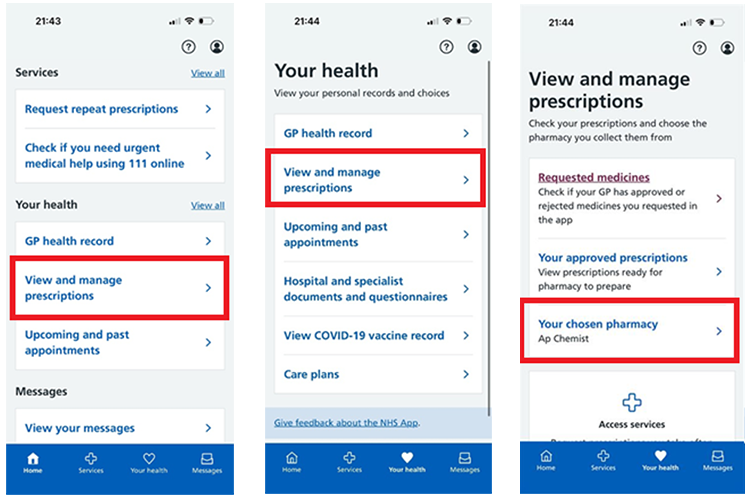
From the Home screen of your NHS app:
- Select: View and manage prescriptions.
- Select: Your approved prescriptions.
- You should see your prescription displayed here.
If your prescription has been sent to your chosen pharmacy, please discuss with the pharmacy in the first instance.
If you are still continuing to experience issues, please contact your prescriber via your patient portal.
For urgent concerns, please contact our Patient Support Centre via Live Chat or by calling: 0330 124 1980 (available Mon-Fri, 8am-6pm).
The easiest way to choose your nominated pharmacy is via the NHS app (see below), or by logging into the NHS website via web browser.
Once you have chosen a pharmacy, they will receive your prescriptions until you change or remove it.
You can ask your prescriber to send your prescription to a pharmacy that is not your nominated pharmacy, on a one-off basis, but your prescriber cannot permanently change your nominated pharmacy for you.
Check if you already have a chosen pharmacy
- Log in using the NHS App or website.
- Go to the Home page or Your health.
- Select View and manage prescriptions.
- If you already have a chosen pharmacy, you’ll see its name under Your chosen pharmacy. If you do not already have a chosen pharmacy, you’ll see Choose a pharmacy.
How to choose a pharmacy
- Log in using the NHS App or website.
- Go to the Home page or Your health.
- Select View and manage prescriptions.
- Select Choose a pharmacy.
- Follow the instructions to choose a pharmacy.
Be aware that if you change your chosen pharmacy, any outstanding prescriptions you’ve requested may still arrive at your current chosen pharmacy.
- Log in using the NHS App or website.
- Go to the homepage or Your health.
- Select View and manage prescriptions.
- Select Your chosen pharmacy. You’ll see the name and details of your chosen pharmacy. To change it, select Change your chosen pharmacy.
- Follow the instructions to choose a pharmacy.
You can download the NHS App on:
- Apple devices (iPhone or iPad) via the Apple App Store or
- Android devices via the Google Play Store

To help avoid delays when collecting your medication from a pharmacy, the following tips may be helpful:
- Choose a pharmacy that you plan to use regularly. Building a relationship with a local pharmacy can make it easier for them to order your medication when needed.
- Contact your pharmacy in advance. The majority of ADHD medications are controlled medicines and pharmacies do not always keep them in stock. Calling ahead allows the pharmacy to confirm availability or arrange to order your medication in.
- Ask the pharmacy to order your medication if needed. Many pharmacies can order ADHD medication once they know a prescription has been issued.
- Let your prescriber know if your pharmacy cannot obtain the medication in time. If there are difficulties obtaining the medication, and it has not been partially dispensed, your pharmacy can release your prescription back into the NHS system, so that another pharmacy can retrieve and dispense it. Please ask the pharmacy for a prescription code if needed.
- Allow a little time for pharmacies to order medication. In many cases, pharmacies can obtain stock within a few days once it has been ordered.
Who Gets Free NHS Prescriptions?
ADHD and prescription charge exemptions
ADHD itself does not qualify for a medical exemption certificate under current NHS rules. This means that patients receiving ADHD medication are not automatically entitled to free prescriptions based on their diagnosis alone.
However, you may still be entitled to free prescriptions if you meet other exemption criteria (for example based on age, benefits, pregnancy, or low income). If you do not qualify for free prescriptions, a Prescription Prepayment Certificate (PPC) may help reduce the cost of multiple prescriptions. You can find out more about PPCs by visiting the NHS website.
You do not have to pay if you meet any of the following criteria:
You are automatically entitled to free prescriptions if you are:
- Under 16.
- 16–18 and in full‑time education.
- 60 or over.
(Your date of birth is usually printed on your prescription. Pharmacies may ask 16–18‑year‑olds to confirm they are in full‑time education).
You can get free NHS prescriptions if you receive:
Income‑based benefits
- Income Support.
- Income‑based Jobseeker’s Allowance.
- Income‑related Employment and Support Allowance.
Your partner and any dependent young people under 20 included in your benefit award are also covered.
Universal Credit
Some people on Universal Credit qualify for free prescriptions, depending on their earnings during the most recent assessment period.
Pension Credit
You are entitled if you receive:
- Pension Credit Guarantee Credit, or
- Guarantee Credit with Savings Credit.
Savings Credit alone does not automatically qualify you, but you may get help through the NHS Low Income Scheme.
You may also be eligible for free prescriptions if you hold a valid certificate.
Maternity Exemption Certificate
Available if you are:
- Pregnant, or
- Have had a baby in the last 12 months.
Medical Exemption Certificate
For certain long‑term medical conditions (e.g. diabetes requiring medication). You must hold a valid certificate.
NHS Low Income Scheme
Depending on your financial situation you may receive:
- HC2 certificate – full help (includes free prescriptions).
- HC3 certificate – partial help (does not cover prescription charges).
War Pension Exemption
Covers prescriptions needed for your accepted disability.
If You’re Not Exempt: Prescription Prepayment Certificates (PPCs)
If you pay for your prescriptions and expect to need multiple items, a Prescription Prepayment Certificate can save you money.
Current options:
- 3‑month PPC: £32.05.
- 12‑month PPC: £114.50.
A PPC covers all your NHS prescriptions during its valid period, no matter how many items you need.
You can apply online via the NHS website.
Unsure Whether You’re Entitled to Free Prescriptions?
Use the NHS eligibility checker.
Electronic Prescribing and Charges
Electronic prescriptions do not change your entitlement. Pharmacies will still ask you to confirm whether you pay for prescriptions and may request proof of exemption.