


If you’ve ever felt as though you don’t fit the ‘classic’ ADHD stereotype, you’re not alone.
ADHD is far more diverse than the narrow behaviours it’s often associated with. It isn’t one thing: it’s many things, often showing up in subtle, complex and highly individual ways.
This year’s ADHD Awareness Month theme, ‘The Many Faces of ADHD’ highlights an important truth: no two people experience ADHD in the same way. Each person’s story is unique, shaped by their environment, sensory needs, support systems and lived experiences.
To mark the month at Psychiatry UK, we launched our Neurodiversity Network – a supportive space for colleagues to learn from one another, share personal experiences, and strengthen understanding across our organisation. It reflects the same principle as the campaign itself: we all benefit when we recognise and make space for different ways of thinking.
We began by acknowledging the way ADHD is still commonly associated with a narrow set of behaviours. It’s often reduced to a stereotype of distraction or fidgeting, yet in reality, it appears in far more nuanced and varied ways.
ADHD: Beyond the Stereotypes
Despite increasing awareness, ADHD is still frequently misunderstood. Many people picture it as restlessness, distraction or impulsivity – traits often associated with children, particularly boys.
But ADHD can look very different from person to person.
Some individuals are energetic, fast-paced and full of ideas. Others are quiet, introspective and deeply thoughtful.
Many people mask their struggles so effectively that their difficulties go unnoticed, often at a high emotional cost.
Recognising these varied experiences isn’t just about raising awareness. It’s about seeing people clearly – cultivating compassion, challenging assumptions and building environments where neurodivergent strengths can thrive.
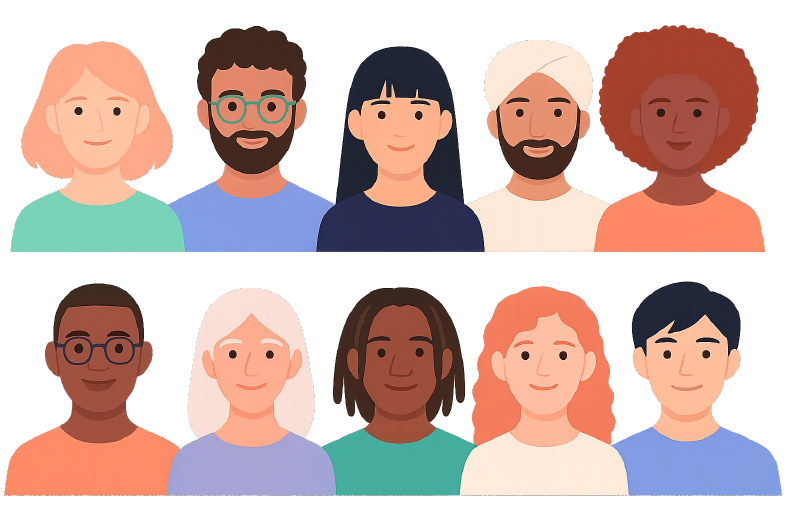
Introducing: The Many Faces of ADHD
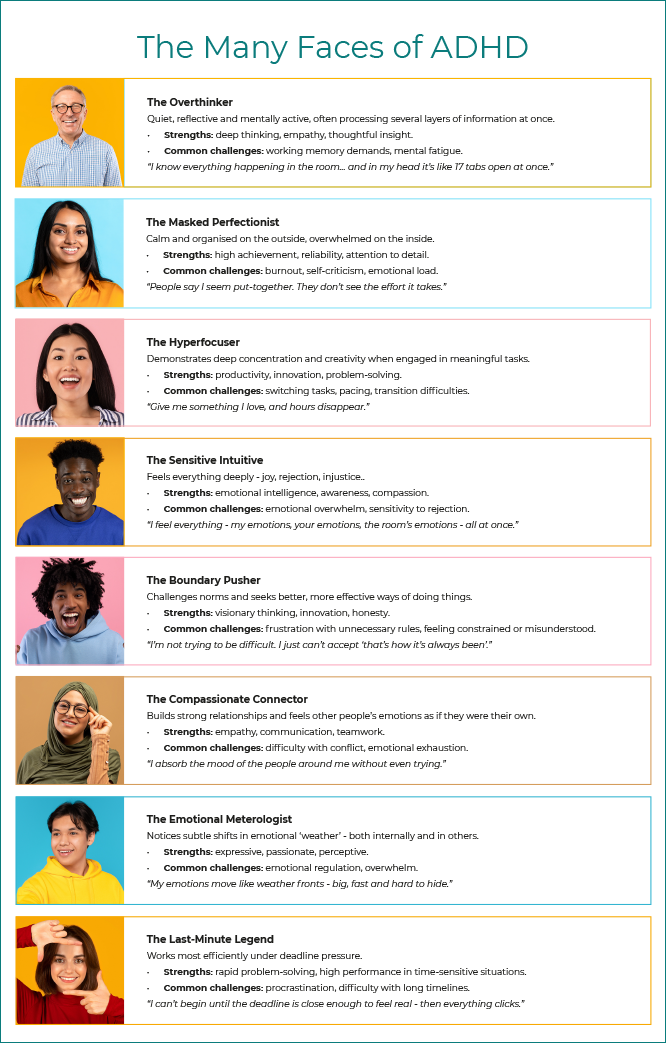
The descriptions below reflect common patterns that may resonate with people living with ADHD. They are not diagnostic categories. They’re relatable snapshots of ADHD traits – reflections of lived experience. Individuals may relate to several of these faces, and their presentation may shift depending on context, energy levels, emotional state or sensory demands.
These profiles help us talk about the diversity of ADHD experiences in a way that is human, validating and accessible.
ADHD Is Dynamic, Not Fixed
These profiles are simply a way to recognise the diversity of lived experiences, not to categorise or limit anyone.
The ‘faces’ often overlap, shift and evolve throughout a person’s life. You may see yourself in several, or different ones depending on your energy, context, environment, sensory load or emotional state.
ADHD is highly dynamic, shifting with circumstances, support systems and daily demands.
Understanding this fluidity helps us to appreciate its full complexity – and to support individuals in ways that acknowledge both their challenges and their strengths.
A Final Note
Whichever faces feel familiar to you, each reflects strengths as well as challenges. Our hope is that recognising these varied presentations encourages greater empathy, better communication and a more inclusive environment for everyone.
We look forward to sharing more stories, insights and conversations through the Neurodiversity Network and future issues of our newsletter.









Leave A Comment