


A summary of the slides presented by our ASD Deputy Clinical Lead, at our ‘What is Autism?’ webinar held on 15 April.
If you missed the webinar, you can watch the recording here.
Many autistic people describe spending much of their life feeling different, without always knowing why.
For some, this feeling has been there since childhood. For others, it becomes more noticeable later in life, often when the demands of work, relationships, parenting, studying, social expectations or day-to-day responsibilities begin to feel harder to manage.
This webinar explored what autism is, how it can present in different people, why it is sometimes missed until adulthood, and what can help after diagnosis.
A note on language
In medical settings, you may still see the term Autism Spectrum Disorder, or ASD. This is because it is the terminology used in diagnostic manuals, such as the DSM-5 and ICD-11.
However, many autistic people prefer terms such as autism, autistic person, or autistic spectrum condition, because autism is not an illness or something that needs to be ‘fixed’. It is a lifelong neurodevelopmental difference.
In this article, we will mainly use the terms autism and autistic people.
I
Autism is a different way of experiencing the world
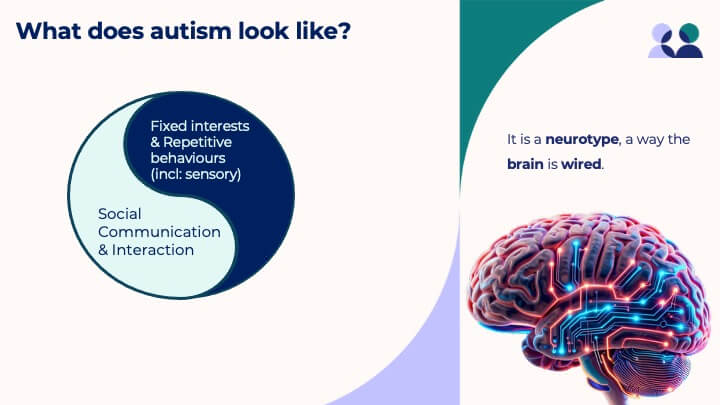
Autism can be understood as a different way the brain is wired. It is not a broken version of a non-autistic brain. It is a different operating system.
Autistic people may communicate, process information, manage sensory input, experience emotions and relate to the world in ways that differ from non-autistic people.
Autism is also a spectrum. This does not mean a straight line from ‘mild’ to ‘severe’. It means that autistic people have different profiles, strengths, needs and challenges. One autistic person may look very different from another.
Autistic differences are present throughout life, but they may become more noticeable at certain points. For example, a person may cope well for many years by using routines, masking, planning or avoiding certain situations. But when life becomes more demanding, those coping strategies may no longer be enough.
This can be one reason why some people only begin to recognise their autistic traits in adulthood.

What do clinicians look for when assessing autism?
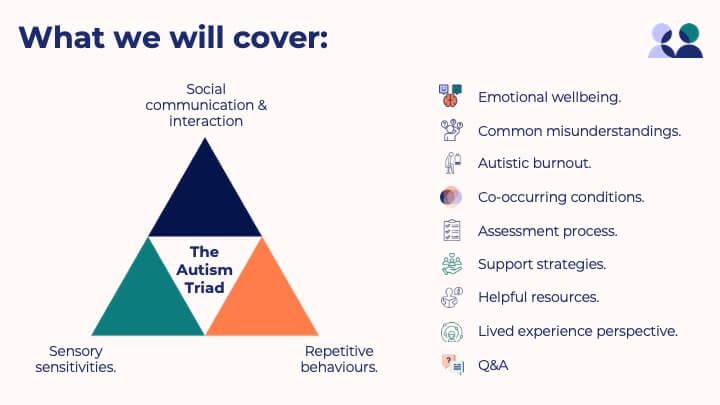
When clinicians assess for autism, they look for patterns across three main areas:
Social communication and interaction
This includes how someone understands social cues, conversations, body language, tone of voice and relationships.
Repetitive behaviours, routines, interests and predictability
This includes the need for routine, strong interests, distress around change, repeated patterns of behaviour, or a strong preference for things being done in a particular way.
Sensory differences
This includes being more or less sensitive to things such as sound, light, smell, taste, touch, movement, body awareness or internal body signals.
These areas are considered alongside the person’s life history, childhood experiences, current challenges and strengths.
Social communication and interaction
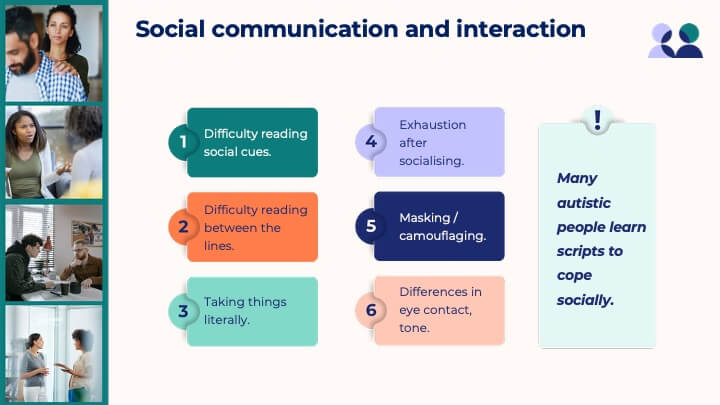
Autistic people may experience social communication differently. This does not mean they do not want connection, friendship or relationships. It means that the ‘rules’ of social interaction may be harder to read, more tiring to follow, or simply less natural.
For example, an autistic person may find it difficult to know when it is their turn to speak in a group conversation. They may not automatically notice subtle pauses, changes in eye contact, shifts in tone, or other cues that non-autistic people may rely on.
They may also find it harder to read between the lines.
For example, if someone says, “Do you want to help me with this?”, an autistic person may hear that as a genuine question and answer honestly. If they say “no”, they may not realise that the other person was making a polite request for help.
This can lead to misunderstandings, especially at work, in families, or in relationships.
Some autistic people also take language more literally. If they ask someone how they are and the person says, “I’m fine,” they may accept that answer at face value. They may not automatically pick up that the person’s tone, facial expression or body language suggests something different.
This is not because autistic people do not care. It is because integrating words, tone, facial expression, body language and context can take more effort.
Why socialising can feel exhausting
Social situations can involve a lot of processing at once.
An autistic person may be trying to follow the conversation, work out when to speak, choose the right words, monitor their facial expression, manage eye contact, process sensory information and avoid being misunderstood.
This can be especially draining in group settings, noisy environments or situations where expectations are unclear.
Some autistic people may enjoy socialising, but still feel exhausted afterwards. They may need time alone to recover, decompress and regulate.
This is important to understand. Needing recovery time after social contact does not mean someone is antisocial or rude. It may simply be part of how they manage their energy.
Masking
Masking is when an autistic person consciously or unconsciously hides, suppresses or adapts their natural responses in order to fit in.
This might include:
- Copying other people’s behaviour.
- Forcing eye contact.
- Rehearsing conversations in advance.
- Preparing ‘safe’ questions or topics.
- Hiding sensory discomfort.
- Suppressing stimming or other self-regulating behaviours.
- Appearing calm while feeling overwhelmed inside.
Masking can help people get through social, work or school situations, but it can also be extremely tiring. Over time, prolonged masking can contribute to anxiety, exhaustion and autistic burnout.
Some people have masked for so long that they find it difficult to know where the mask ends and where their natural self begins.
Eye contact
Eye contact can feel uncomfortable, intense or distracting for some autistic people.
Some may avoid eye contact. Others may have learned to make eye contact because they know it is expected. Some people describe looking between someone’s eyebrows, at their forehead, or just past their face, rather than directly into their eyes.
Again, this is not a sign of disinterest or dishonesty. It may simply be a way of managing sensory or social intensity.
Communication preferences
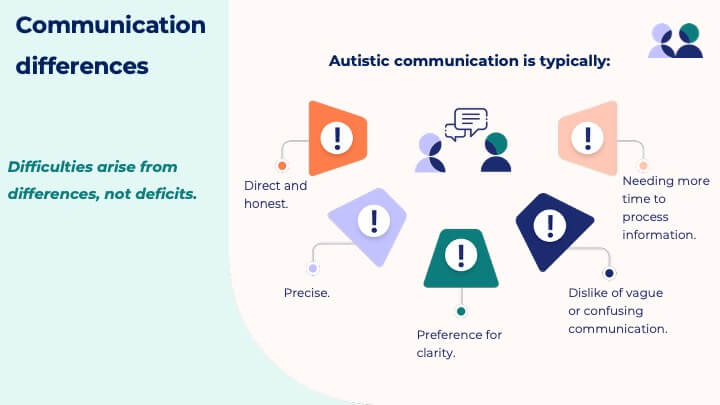
Many autistic people prefer communication that is clear, direct and honest.
This can include:
- Saying exactly what is meant.
- Avoiding hints or vague language.
- Being specific about expectations.
- Allowing extra time to process information.
- Putting important information in writing.
- Explaining changes clearly and in advance where possible.
Direct communication can be incredibly helpful. It reduces uncertainty and makes it easier for the person to understand what is being asked or expected.
Interests, routines and predictability
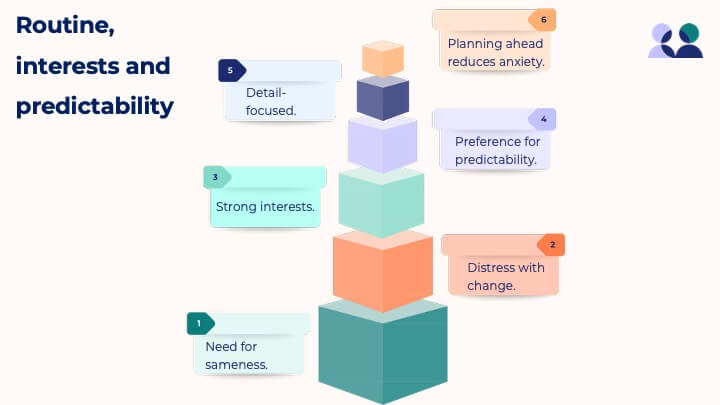
Many autistic people have strong interests. These may be deeply absorbing, detailed and important.
An autistic interest can bring enjoyment, but it can also do more than that. It may act as a way to regulate emotions, reduce stress, recover from overwhelm, or create a sense of safety.
For some people, an interest may become an area of deep knowledge and expertise. This can be a real strength, particularly if it connects with their work, study or creative life.
Autistic people may also have a strong need for predictability. This might include eating the same foods, taking the same route, planning ahead, keeping routines, or doing things in a particular order.
These routines are not simply ‘habits’. They can help reduce uncertainty and anxiety. Sudden changes, last-minute plans or unclear expectations can feel very unsettling, especially when someone is already tired or overloaded.
Sensory differences
Sensory differences are a key part of autism.
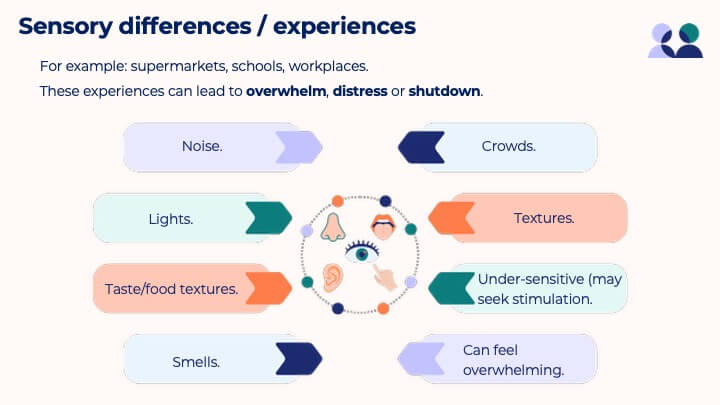
Some autistic people are hypersensitive, which means they experience certain sensory input very intensely. Others are hyposensitive, which means they may need more sensory input to feel regulated. Many people experience a mixture of both.
Sensory differences can affect:
- Sound, such as loud noises, background noise or high-pitched sounds.
- Light, such as bright lights, flickering lights or fluorescent lighting.
- Touch, such as clothing labels, seams, textures or unexpected touch.
- Smell, such as perfumes, food smells or cleaning products.
- Taste and texture, especially around food.
- Movement and balance.
- Body awareness.
- Internal signals, such as hunger, thirst, pain, temperature or needing the toilet.
For example, an autistic person may not notice they are hungry or thirsty until they feel unwell. Or they may become so focused on an activity that they do not register body signals straight away.
Sensory differences can also affect eating. Sometimes food-related difficulties are linked to texture, smell, taste, temperature, unpredictability or anxiety, rather than body image concerns.
Thinking styles and attention to detail
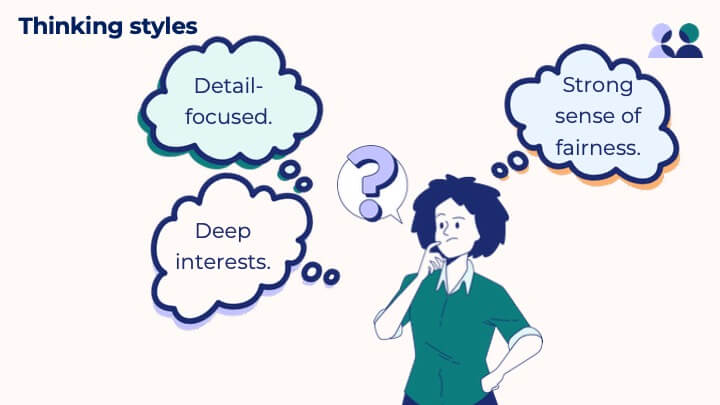
Autistic people often have a strong focus on detail. They may notice patterns, inconsistencies or errors that others miss.
Many autistic people also have a strong sense of fairness or justice. This can be a strength, but it can also be distressing when rules are not followed, people are treated unfairly, or systems do not work as they should.
In the workplace, for example, an autistic person may feel very unsettled if guidance says one thing but people do something different in practice. This is not about being difficult. It may come from a deep need for consistency, clarity and fairness.
Autistic people do feel emotions
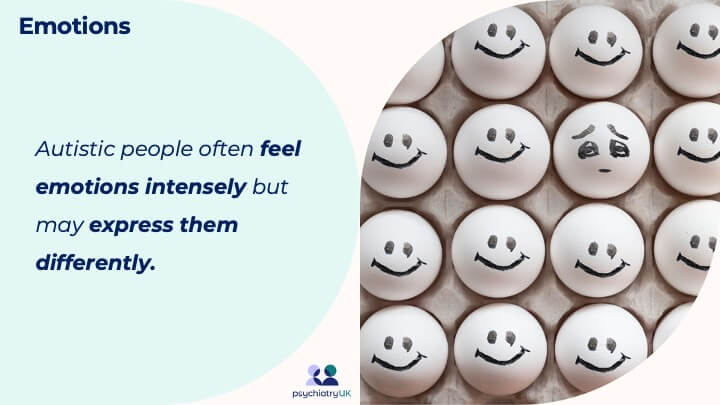
One common myth is that autistic people do not feel emotions or lack empathy.
This is not true.
Autistic people may feel emotions very strongly. They may experience deep empathy, care and concern for others. What may differ is how those emotions are expressed, recognised or communicated.
Some autistic people may not show emotion in the way others expect. Some may need more time to identify what they are feeling. Others may feel emotions so intensely that they become overwhelmed, shut down or unable to speak.
Different expression does not mean absence of feeling.
Autistic burnout
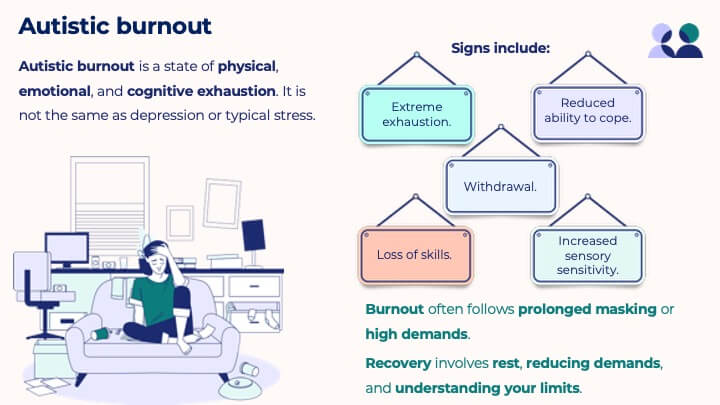
Autistic burnout is a state of deep physical, emotional and cognitive exhaustion.
It can happen after a long period of coping with demands that exceed a person’s capacity. This might include work pressure, family responsibilities, sensory overload, social demands, conflict, masking, or repeated changes.
Autistic burnout may involve:
- Extreme exhaustion.
- Withdrawal from other people.
- Reduced ability to cope with everyday tasks.
- Increased sensory sensitivity.
- Loss of skills or reduced functioning.
- Difficulty communicating.
- Needing much more rest than usual.
Autistic burnout can sometimes be misunderstood or misdiagnosed as depression, anxiety or another mental health difficulty. These can also co-exist, but autistic burnout has its own pattern and often needs a reduction in demands, more recovery time, sensory support and validation.
Co-occurring conditions
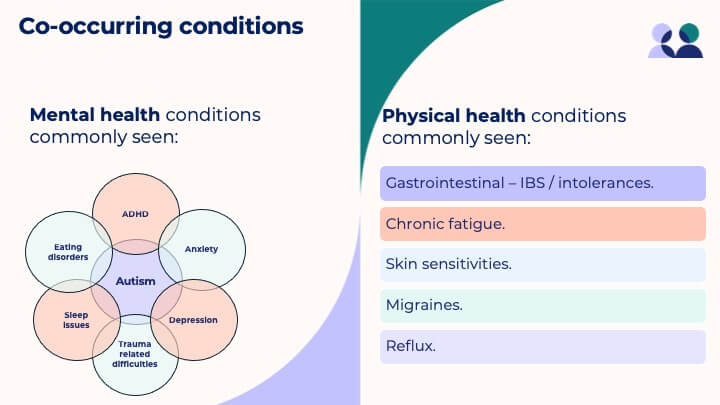
Autism often overlaps with other neurodevelopmental, mental health and physical health conditions.
There is a significant overlap between autism and ADHD. Some people are diagnosed with one first, and only later realise that the other may also be present.
Autistic people may also experience anxiety, depression, eating difficulties, sleep problems or trauma-related difficulties.
There can also be links with physical health difficulties, including bowel symptoms, food intolerances, chronic fatigue, migraines, reflux, skin sensitivities and fibromyalgia.
This does not mean every autistic person will experience these conditions. But it is helpful to be aware that autism can affect more than communication alone. It can be part of a person’s wider physical, emotional and sensory profile.
Why life can feel harder
Many autistic people compare themselves with others and wonder why everyday life seems to take more effort.
This can be painful, especially when other people appear to manage the same situations more easily.
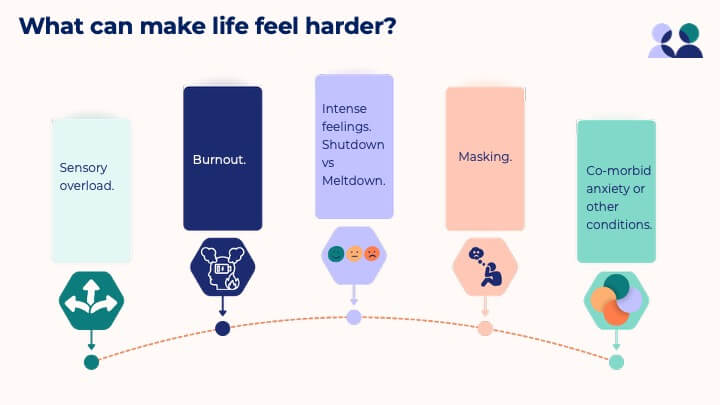
There are many reasons why life may feel harder for an autistic person. These can include:
- Sensory overload.
- Social exhaustion.
- Masking.
- Anxiety.
- Depression.
- Trauma.
- Shutdowns or meltdowns.
- Uncertainty or change.
- Unclear expectations.
- Lack of adjustments.
- Trying to function in environments not designed for autistic needs.
When these factors build up, even ordinary tasks can feel overwhelming.
Support often begins with recognising that the person is not failing. Their needs may simply not have been understood or accommodated.
Common misunderstandings about autism
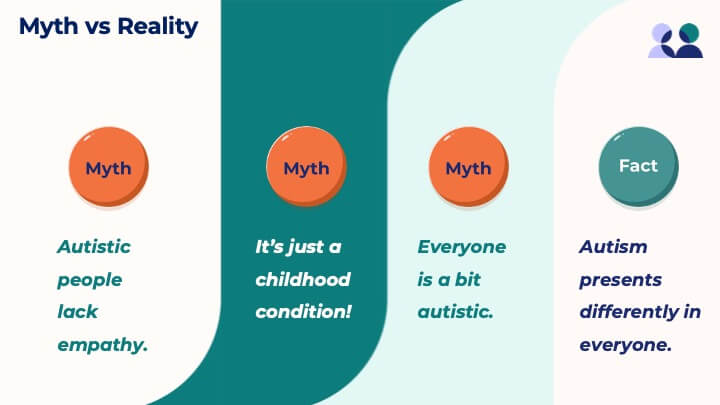
There are still many misunderstandings about autism.
One common comment is: “You don’t look autistic.”
But autism does not have one look. Many autistic people have spent years learning how to appear non-autistic. Some may be highly skilled at masking, especially in short interactions, professional settings or familiar roles.
Another misunderstanding is: “You’re too social to be autistic.”
Autistic people can want connection. They can have friendships, relationships, families and social lives. The difference may be in how social interaction is experienced, how much energy it takes, and what support or recovery is needed afterwards.
Another common misunderstanding is: “It’s just anxiety.”
Anxiety may be present, but sometimes anxiety develops because an autistic person has spent years navigating environments that feel unpredictable, overwhelming or unsafe. Understanding autism can help explain why anxiety is there and what kind of support may actually help.
And finally, “Everyone is a bit autistic” is not accurate. Everyone may relate to some individual traits, such as liking routine or feeling overwhelmed sometimes. But autism is a lifelong neurodevelopmental profile that affects how a person experiences and processes the world.

How autism is assessed at Psychiatry UK
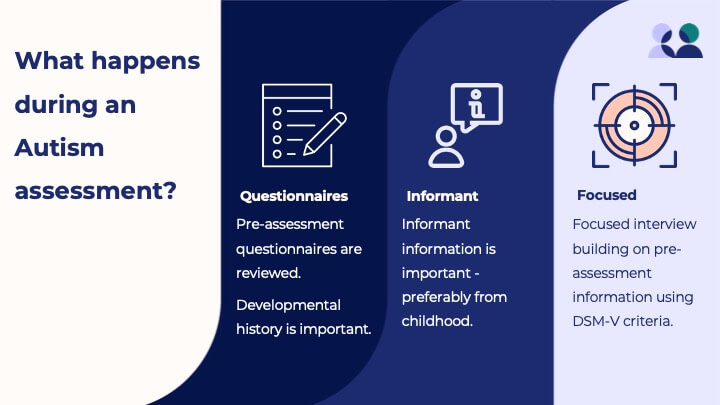
An autism assessment usually begins with questionnaires.
The patient completes a self-report questionnaire about their experiences, both now and earlier in life. An informant questionnaire is also requested where possible. This is usually completed by someone who knew the person in childhood, although if this is not possible, someone who knows the person well may be able to help.
If no informant is available, the assessment can still go ahead using the information that is available.
Once the questionnaires have been reviewed, the patient is invited to an appointment with a clinician. The appointment builds on the information already provided. The clinician will usually focus on areas that need more detail or clarification, using the diagnostic criteria as a guide.
In many cases, the clinician can explain the outcome at the end of the assessment. Sometimes, a second appointment may be needed. Very occasionally, it may not be possible to reach a clear conclusion, although this is uncommon.
Late diagnosis
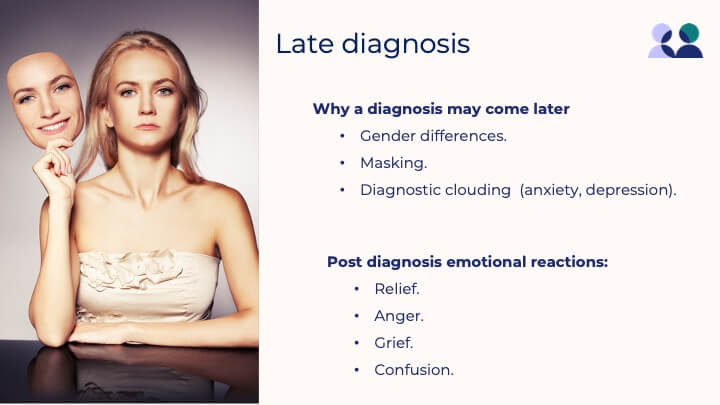
There are many reasons someone may not be diagnosed until adulthood.
They may have masked their difficulties for many years. Their traits may have been misunderstood as anxiety, depression, personality difficulties, shyness, sensitivity or simply ‘being different’. Gender can also play a role, as autism has historically been recognised more easily in boys and men.
Receiving a diagnosis later in life can bring many different emotions. Some people feel relief. Some feel grief, anger, sadness, confusion or regret for the years they spent without understanding why things felt so hard.
All of these responses are valid.
A diagnosis can help explain the past, but it can also bring a period of adjustment. It may take time to process what it means and how it changes the way someone understands themselves.
After diagnosis
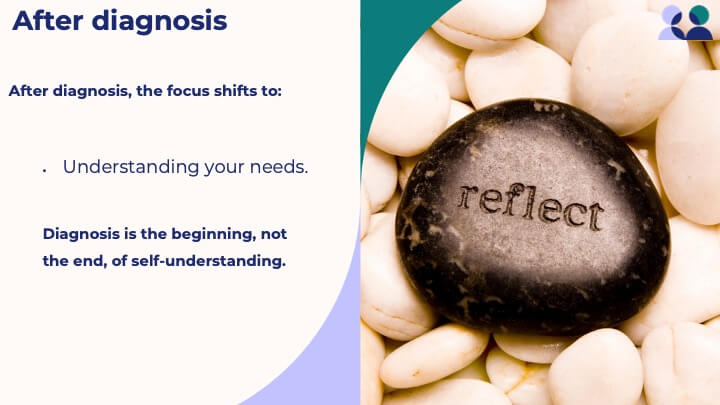
For many people, diagnosis is not the end of the journey. It is the beginning of a new stage of self-understanding.
A diagnosis can help someone make sense of their experiences. It can validate difficulties that may have been dismissed or misunderstood. It can also help people recognise their needs, protect their energy and advocate for adjustments.
Some people describe feeling ‘more autistic’ after diagnosis. Often, what they mean is that they feel more aware of their autistic traits, or more able to be themselves without masking as much.
This can feel both freeing and unsettling.
Autistic strengths
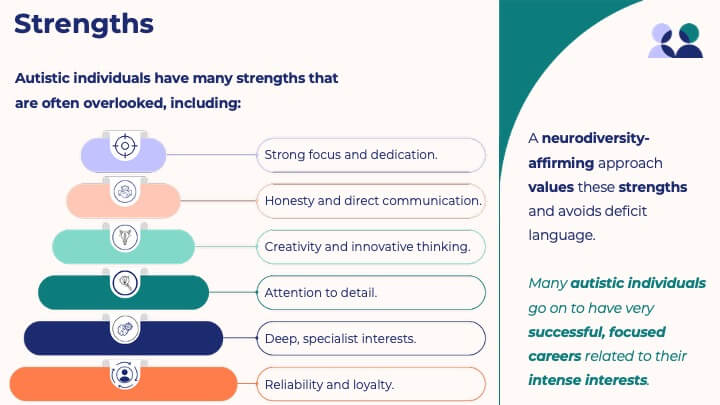
Autism can bring real strengths.
These may include:
- Reliability.
- Loyalty.
- Honesty.
- Deep focus.
- Strong attention to detail.
- Creativity.
- Innovative thinking.
- Dedication.
- Specialist knowledge.
- Strong values.
- Direct communication.
It is important not to talk about autism only in terms of challenges. Support should also help autistic people recognise and use their strengths in ways that feel meaningful and sustainable.
Support strategies
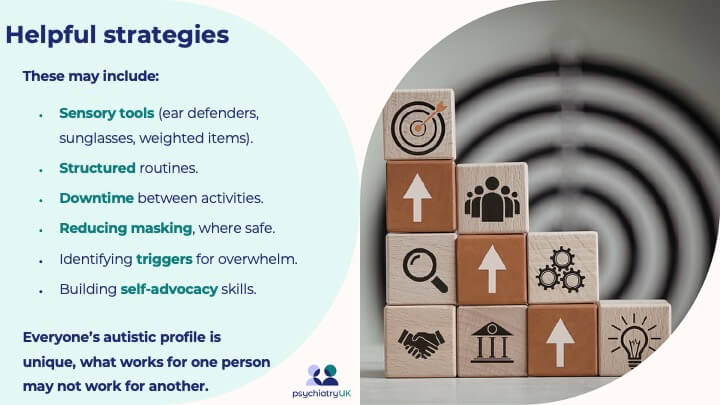
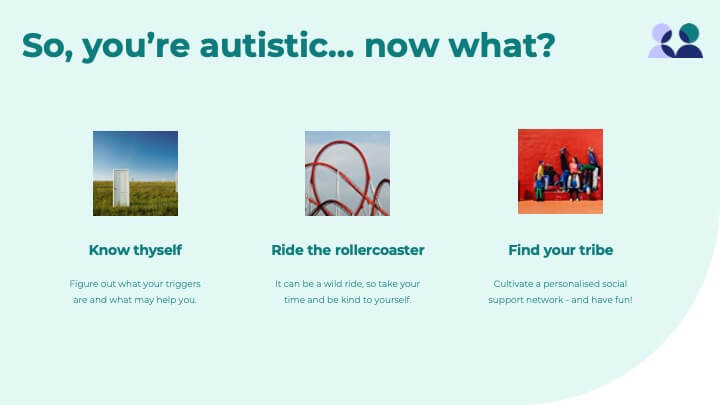
Support after diagnosis often begins with learning more about autism and understanding your own profile.
Because autistic people are all different, the most helpful strategies will vary from person to person.
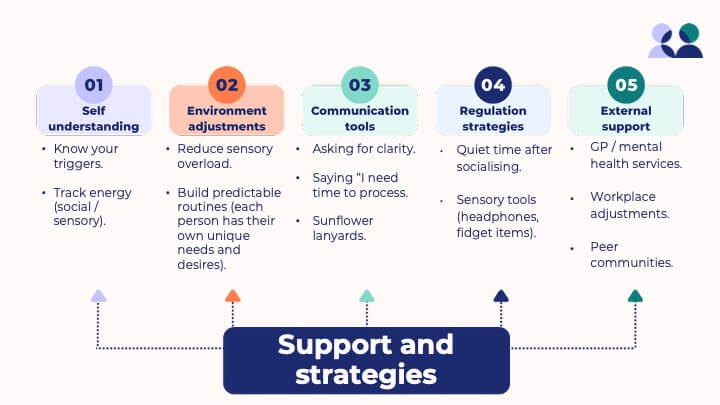
Some useful areas to explore include:
Understanding your triggers
It can help to notice what tends to cause overwhelm, shutdown, anxiety or exhaustion. This might include noise, bright lights, social demands, unexpected change, conflict, uncertainty or too many tasks at once.
Tracking your energy
Some activities may fill your cup. Others may drain it. Understanding this can help you plan your week in a way that protects recovery time.
Reducing sensory overload
This might include using noise-cancelling headphones, Loop-style earplugs, sunglasses, softer lighting, comfortable clothing, fidget items, quiet spaces or changes to your environment.
Building routine and predictability
Routines can support regulation. Visual plans, written instructions, reminders, calendars and preparation time can all help reduce uncertainty.
Communicating your needs
It can be helpful to tell trusted people how you prefer to communicate. For example, you may prefer written information, clear instructions, advance notice of plans, direct language or extra processing time.
Planning recovery time
If a social event, appointment or workday is likely to be draining, it can help to plan quiet time afterwards. This is not a luxury. For many autistic people, it is an important part of staying well.
Finding community
Some people find support through autistic-led communities, peer groups, online spaces, therapy, coaching, family, friends or workplace support. The right support can help people feel less alone and more understood.
Reasonable adjustments
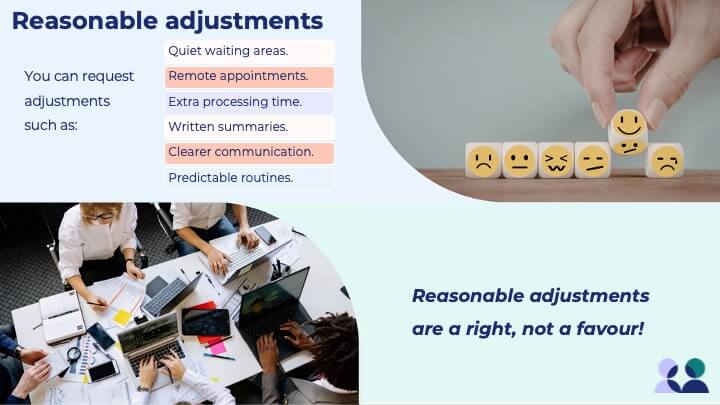
Autistic people may be able to request reasonable adjustments in work, education or healthcare settings.
At work or in education, helpful adjustments might include clearer written instructions, reduced sensory demands, predictable routines, flexible communication methods, quiet spaces, or changes to meeting formats.
In healthcare settings, it may help to ask for a quieter waiting area, longer appointments, written information, clear explanations, or extra time to process questions.
The most useful adjustments are usually the ones linked to the person’s own needs. Understanding your profile can make it easier to explain what would help.

Zoe’s lived experience: a late diagnosis
The webinar also included a lived experience talk from Zoe, who spoke about being diagnosed as autistic in adulthood.
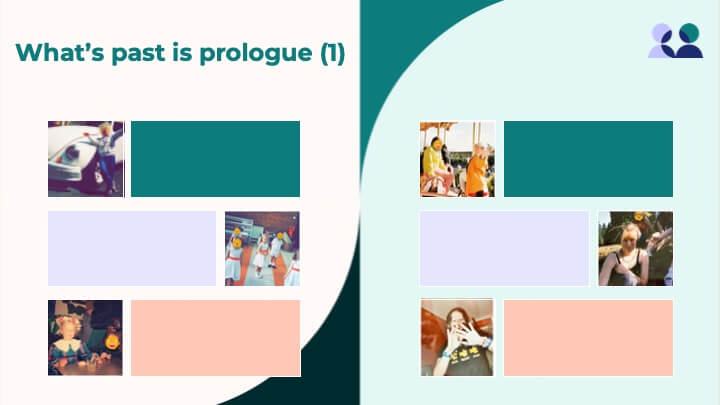
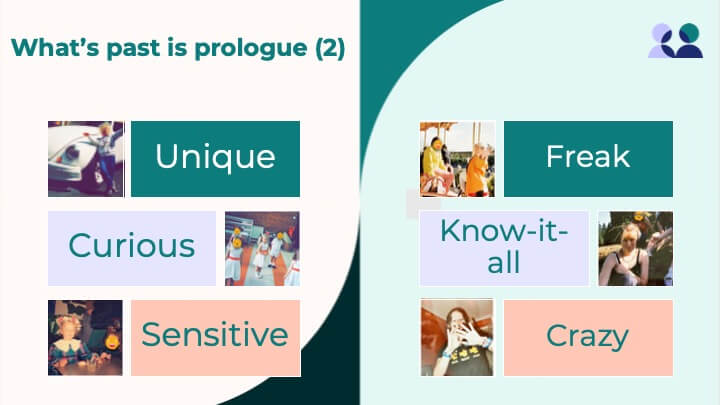
Zoe described being seen as a child as an ‘old soul’ who marched to the beat of her own drum. She had deep interests, including ancient Egypt and space, and would memorise information from books. She watched favourite films and cartoons repeatedly, copied accents and phrases, and had strong food and sensory preferences.
As she got older, the labels other people used became less kind. She described feeling like an alien on another planet with no instruction manual. Social rules seemed to change, friendships became harder to understand, and she became more withdrawn, anxious and depressed.
For many years, she did not consider that she might be autistic or have ADHD. In adulthood, after a period of grief, major life changes and mental health support, she began to explore whether there might be another explanation for her experiences.
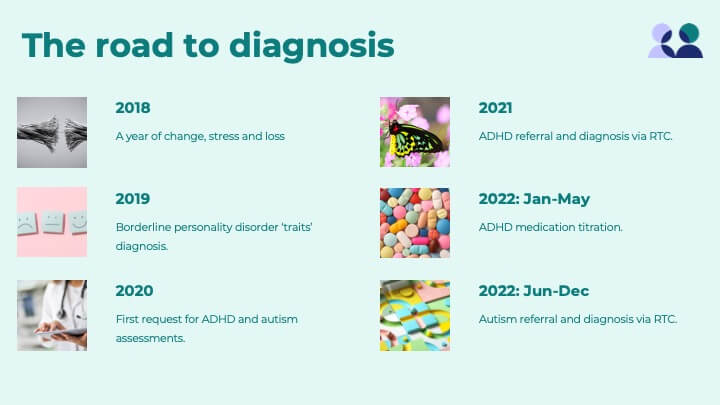
She was first diagnosed with ADHD. After treatment and greater self-awareness, she began to notice that some difficulties around social communication, anxiety and rigidity were still present. This led her to seek an autism assessment.
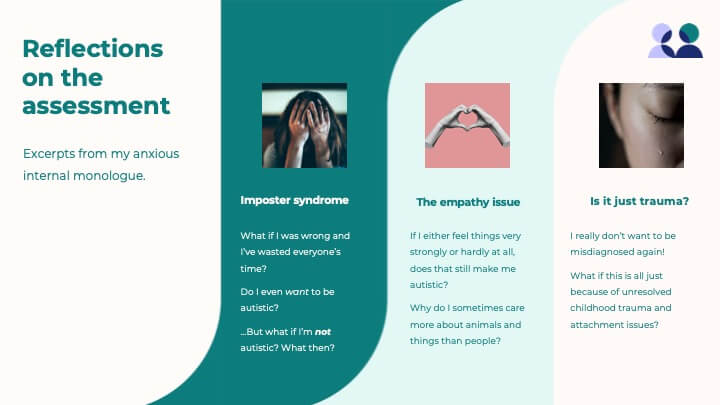
Zoe described feeling imposter syndrome before her assessment and worrying that she might not get answers. But her diagnosis brought relief and validation, even though it also came with mixed emotions.
For Zoe, diagnosis was not the end of the journey. It was the beginning of learning more about herself, recognising what she needed, finding people she could be herself with, and speaking more openly about her experiences.
Her message was clear: being autistic can be hard, and autistic burnout is real. But understanding yourself can make it possible to find the right tools, the right support and the right people.
Final thoughts
Autism is not one single presentation. It can look different in every person.
Some autistic people are diagnosed in childhood. Others only begin to understand themselves in adulthood, often after years of feeling different, anxious, exhausted or misunderstood.
A diagnosis can bring clarity, validation and a new way of making sense of the past. It can also open the door to support, adjustments, self-advocacy and community.
Most importantly, autism is not a failure or a flaw. It is a different way of experiencing the world. With understanding, acceptance and the right support, autistic people can begin to build lives that work better for them.









Leave A Comment