

Neurodiversity and Workplace Adjustments
An overview of our patient webinar, ‘Creating a Workplace that Works for Everyone’, held on 6 October 2026.
For neurodivergent people, everyday workplace expectations can sometimes create challenges. Busy environments, unclear instructions, unexpected changes and competing priorities may make it harder to concentrate, stay organised or manage energy levels.
However, even small adjustments can make a meaningful difference.
In our recent patient webinar, Dr Sam Spavin, ADHD Clinical Director for ADHD Assessment and Ongoing Care at Psychiatry UK, explored how recognising workplace barriers and making reasonable adjustments can help neurodivergent people work more comfortably and effectively.
We also heard from Phoebe and Katelyn, who shared their personal experiences of overcoming workplace challenges and finding approaches that work for them.
This article brings together the key information, advice and practical suggestions shared during the session.
Key takeaways
- Neurodivergent people experience work differently. The working environment, communication styles and everyday expectations can all affect how comfortably and effectively someone works.
- Small changes can make a big difference. Clearer instructions, quieter workspaces, flexible arrangements and practical organisational tools can help reduce workplace barriers.
- Reasonable adjustments are about fairness, not special treatment. Under the Equality Act 2010, employers have a duty to make reasonable adjustments for disabled workers and job applicants in relevant circumstances.
- You don’t need to have all the answers before asking for support. Start by explaining what you find difficult, how it affects your work and what changes might help. You can explore solutions together with your employer.
- There is no one-size-fits-all approach. Everyone’s needs are different, and adjustments may need to change over time. Finding what works for you can involve trying different approaches.
What do we mean by neurodiversity?
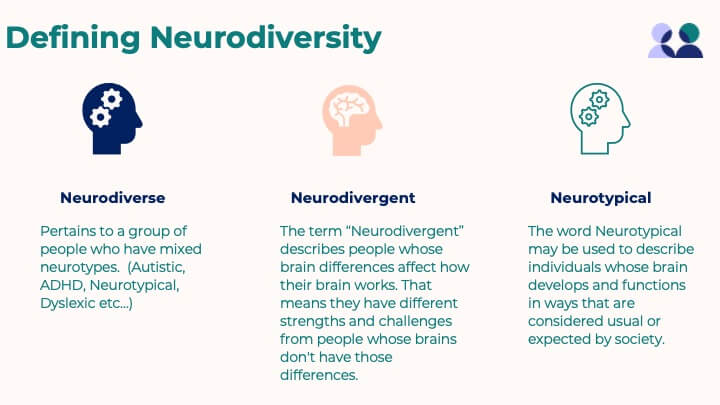
Neurodiversity describes the natural differences in how people’s brains work, including how we think, learn, communicate and process information.
The term neurodivergent is often used to describe people whose way of thinking or processing information differs from what society typically expects.
This can include autistic people, as well as people with ADHD, dyslexia, dyspraxia, dyscalculia and Tourette’s syndrome. If you have had an autism assessment, you may also see the term autism spectrum disorder, or ASD, in your report.
Everyone’s experience is different. Two people with the same diagnosis may have very different strengths, difficulties and support needs.
The important thing is to understand each person’s individual abilities and experiences, rather than making assumptions based on their diagnosis.
Why can work feel more difficult for neurodivergent people?
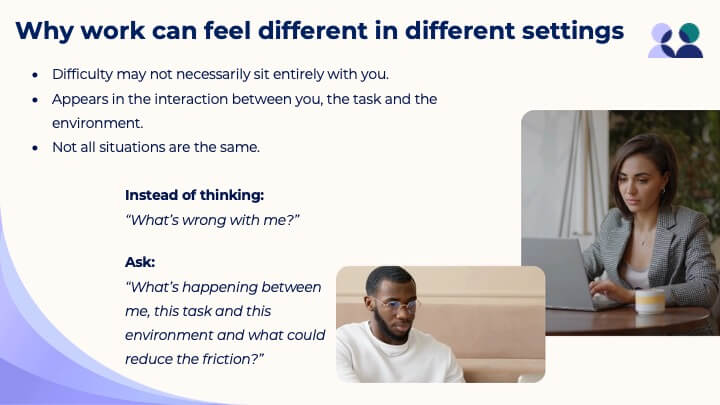
Difficulties at work are not always about a person’s abilities. Often, they arise from the interaction between the individual, the task and the working environment.
For example, you might find it easy to write a detailed report in a quiet room but struggle to complete the same task in a busy office with constant interruptions.
You may also spend considerable energy masking difficulties or adapting your behaviour to meet workplace expectations.
Recognising these challenges can help you identify changes that might make working life easier.
Recognising workplace barriers
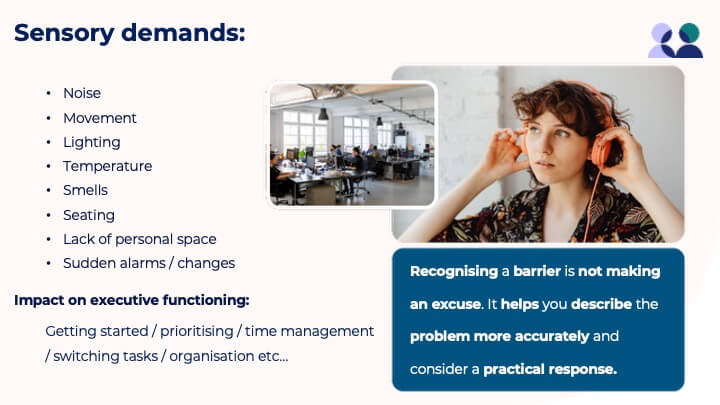
Workplace barriers are not always obvious. They may be built into everyday routines, communication styles or expectations.
Common examples include:
- Sensory demands: Noise, bright lighting, strong smells or busy environments.
- Unclear communication: Vague instructions or important information being shared only verbally.
- Frequent interruptions: Difficulty maintaining concentration when colleagues interrupt tasks.
- Competing priorities: Several people assigning work without clear guidance about what should come first.
- Unexpected changes: Last-minute changes to schedules, responsibilities or working arrangements.
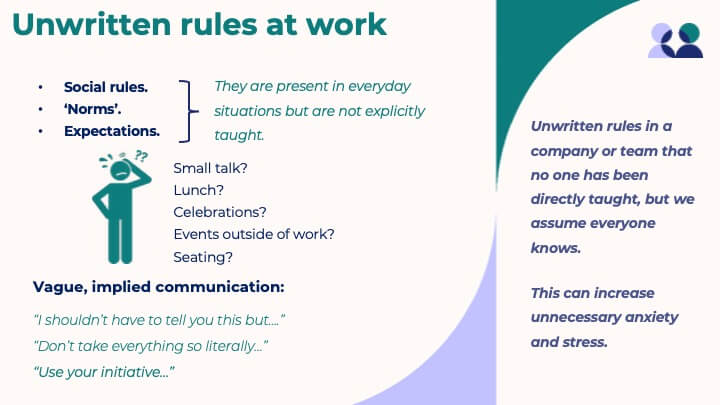
- Unwritten rules: Social expectations about workplace behaviour that nobody has clearly explained.
Recognising these barriers is not about making excuses. It is about understanding what makes a situation difficult and identifying practical ways to improve it.
Understanding reasonable adjustments
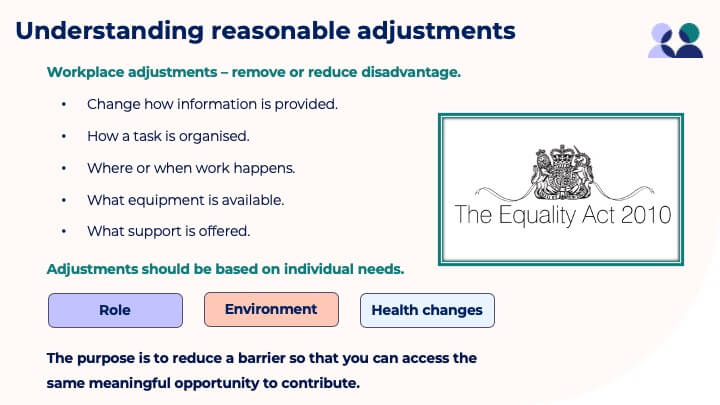
A reasonable adjustment is a change made to reduce or remove a disadvantage experienced by a disabled person.
Under the Equality Act 2010, employers have a legal duty to make reasonable adjustments for disabled workers and job applicants in relevant circumstances.
Whether someone meets the legal definition of disability depends on how their condition affects them, rather than simply whether they have a particular diagnosis.
Adjustments might involve changes to the working environment, the way information is communicated, working hours or the equipment and support available.
Reasonable adjustments are not about giving someone an unfair advantage. They are about removing barriers so that people have a fair opportunity to contribute and demonstrate their abilities.
Practical adjustments that may help
Making communication clearer
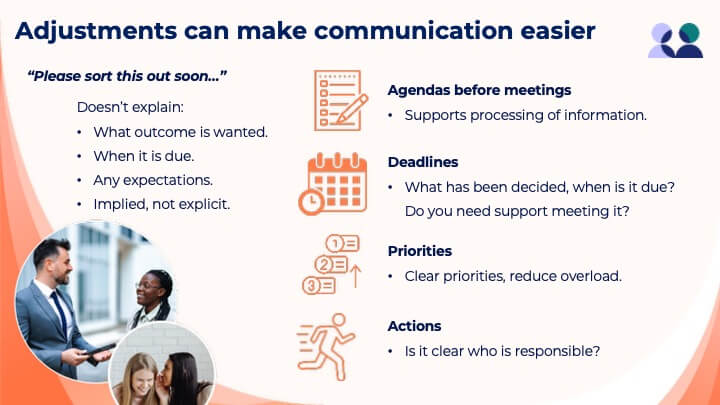
Vague instructions can create unnecessary uncertainty.
For example, being asked to ‘sort something out soon’ leaves important questions unanswered. What exactly needs doing? When is it needed? How important is it compared with other tasks?
Clearer communication can make a significant difference.
Helpful adjustments may include written instructions, specific deadlines, meeting agendas shared in advance and written summaries of agreed actions.
Protecting focus and energy
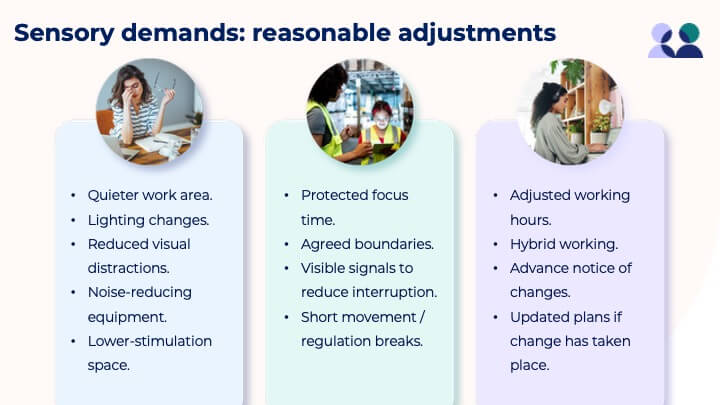
Busy workplaces and frequent interruptions can make it difficult to concentrate.
Some people benefit from quieter workspaces, noise-reducing headphones, reduced visual distractions or protected periods of uninterrupted working time.
Flexible working arrangements, predictable schedules and short movement breaks may also help.
The aim is to reduce avoidable demands so that people can use their energy more effectively.
Supporting organisation and executive functioning
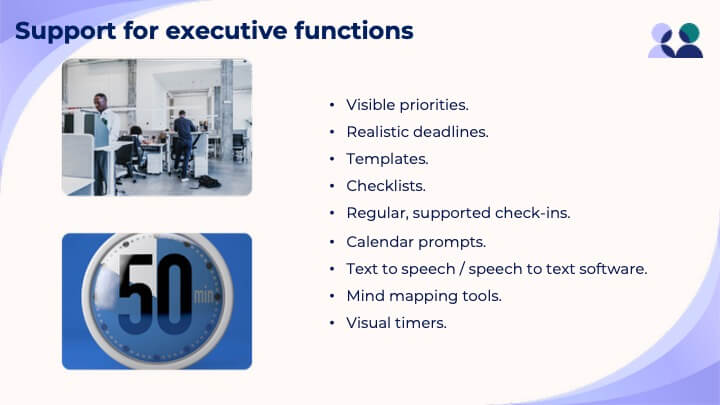
Executive functions help us plan, organise, remember information, manage time and move between tasks.
Differences in executive functioning can make it difficult to get started on tasks, decide what to prioritise or remember several instructions at once.
Practical support might include:
- Breaking larger projects into smaller stages.
- Using visual task boards, such as Kanban or Trello.
- Agreeing clear priorities and realistic deadlines.
- Using checklists, templates and calendar reminders.
- Having regular, supportive check-ins with a manager.
- Using assistive technology, such as speech-to-text tools or visual timers.
Adjustments throughout your working life
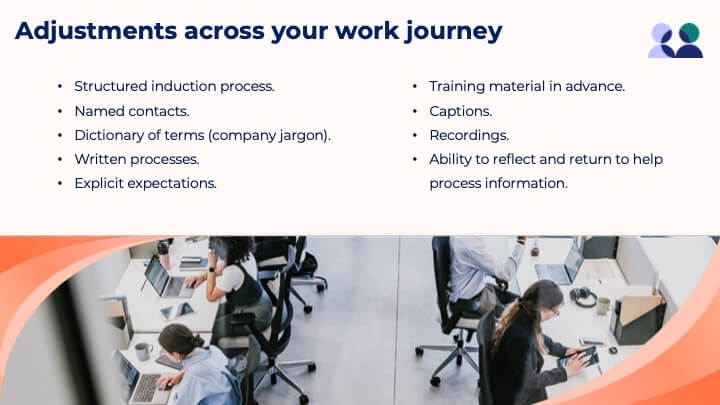
Workplace adjustments can be helpful at different stages of your career, from recruitment and starting a new role to training and progression.
For example, you might benefit from accessible interview materials, a structured induction programme, written instructions or additional time to process information.
The aim is to ensure that people can demonstrate their abilities without being disadvantaged by unnecessary barriers.
How to ask for workplace adjustments
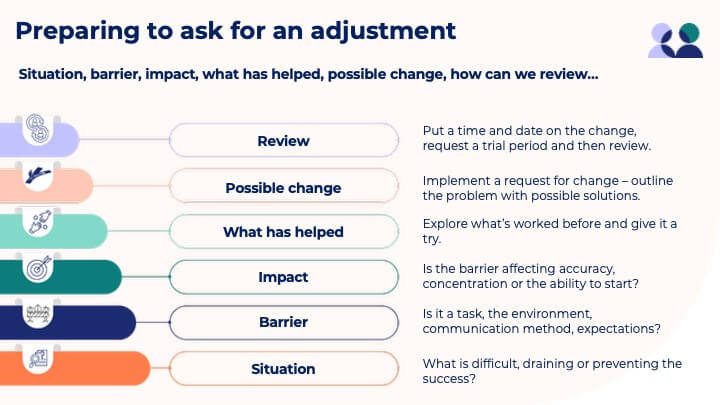
Starting a conversation about workplace adjustments can feel daunting, particularly if you have previously experienced misunderstanding or felt pressure to manage difficulties without support.
Dr Spavin suggested a simple approach to help prepare:
- Identify the difficulty. What situations or tasks are creating problems?
- Recognise the barrier. Is it the environment, communication, workload or something else?
- Explain the impact. How does it affect your concentration, accuracy, energy or ability to complete work?
- Consider what might help. Are there adjustments that have worked before or that might be worth trying?
- Suggest a change. Explain what you think may help and consider agreeing to a trial period.
For example:
‘I’m finding it difficult to process several verbal instructions at once. A written summary with clear priorities and deadlines would help me complete my work accurately. Could we try this for four weeks and then review how it’s working?’
You do not need to have a perfect solution before starting the conversation.
Working together to find solutions
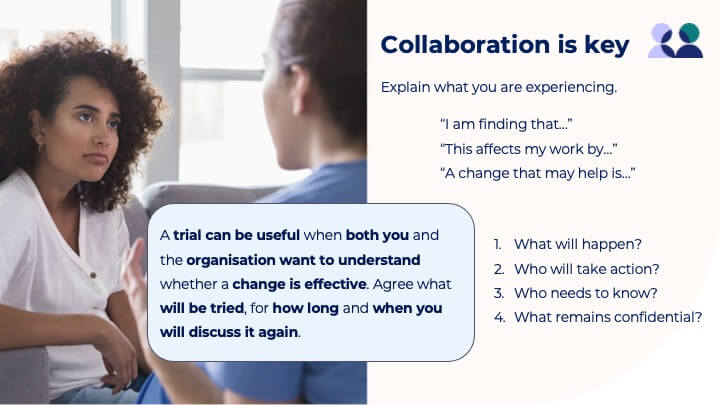
A helpful conversation should focus on understanding the difficulty and exploring practical changes together.
You may already know what would help, or you may need time to explore different approaches.
Agreeing to try an adjustment for a set period can help you and your employer understand whether it is effective.
It is also important to clarify what will happen next, who is responsible for taking action and when the arrangement will be reviewed.
What if the process feels difficult?
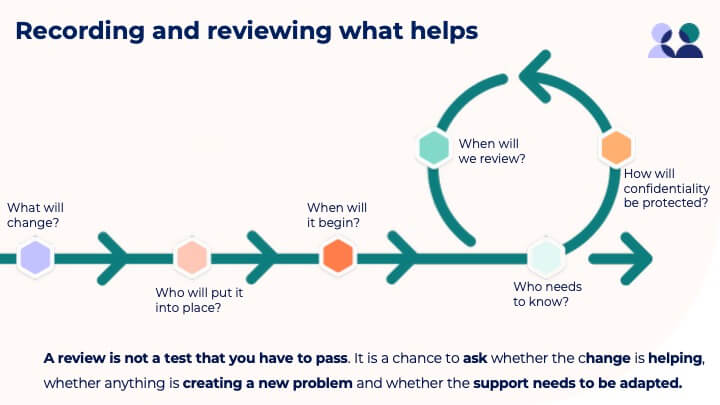
Sometimes requesting adjustments can itself feel overwhelming.
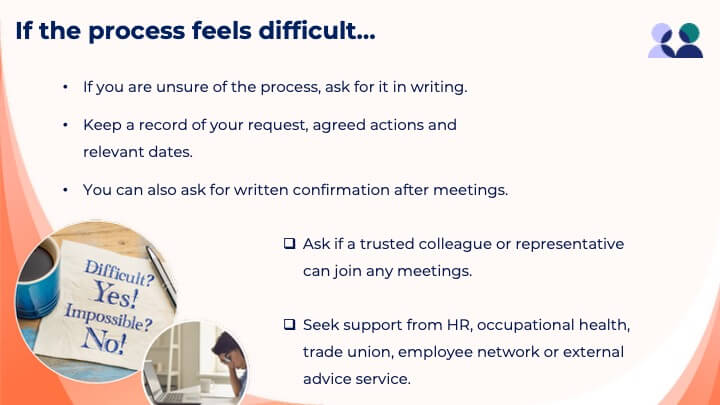
If the process is unclear or taking longer than expected, you may find it helpful to:
- Ask for the process and agreed actions in writing.
- Keep a record of requests, meetings and decisions.
- Seek support from HR, occupational health or a trade union.
- Ask why a particular adjustment cannot be agreed and explore alternatives.
- Consider a workplace adjustment passport to record agreed support needs.
Adjustments should also be reviewed when your role, circumstances or needs change.
Understanding what works for you
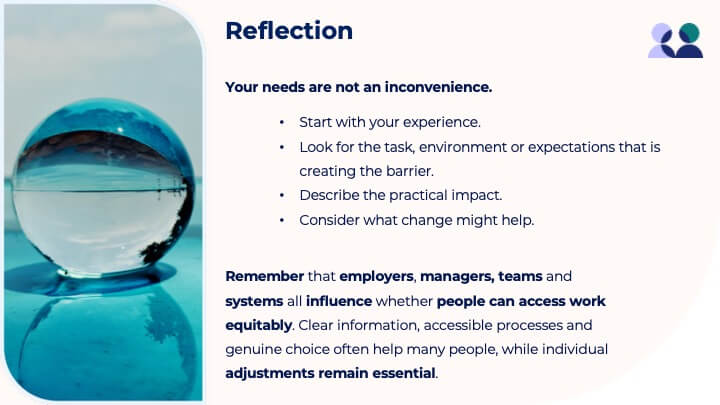
There is no single approach that suits every neurodivergent person.
Some people may need a quieter workspace, while others work best in busy, stimulating environments. Some benefit from detailed planning, while others prefer flexibility.
The important thing is recognising your individual needs and finding ways to work that support your wellbeing and abilities.
Workplace inclusion is also a shared responsibility. Employers, managers and colleagues all have a role in creating environments where people can contribute effectively.
Living with neurodivergence at work: Phoebe’s story
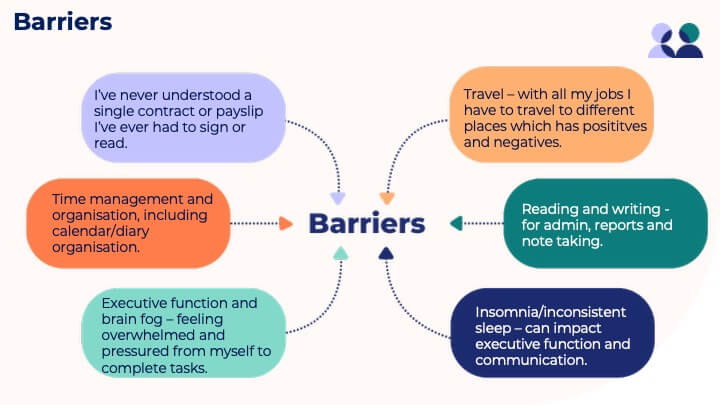
Phoebe shared her experience of living with ADHD and other health conditions, and how these have influenced her working life.
She now uses her personal experiences to support others and educate healthcare professionals through lived experience roles.
Although she has found these roles generally understanding of neurodivergent needs, she explained that challenges can still arise.
Planning journeys between different work locations can be particularly stressful, while reading, writing and processing large amounts of information can require considerable effort.
Phoebe has developed strategies such as writing information down immediately, maintaining routines and finding ways to motivate herself when tasks feel difficult to begin.
She also highlighted how disrupted sleep can affect concentration, communication and everyday functioning.
Her experience demonstrates how a working arrangement can bring both benefits and challenges. For Phoebe, travelling to different locations provides variety, but the planning involved can create additional demands.
Finding the right adjustments: Katelyn’s story
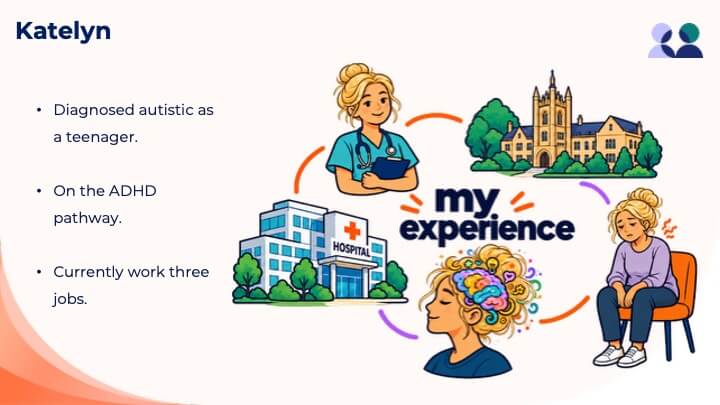
Katelyn shared her experiences as an autistic adult working in several roles, including a busy Accident and Emergency department.
On paper, A&E might appear to be a challenging environment for an autistic person. It is noisy, unpredictable and fast-paced, with bright lighting and frequent interruptions.
However, Katelyn loves her work and finds it extremely rewarding.
Over time, she has become more confident in recognising workplace barriers and discussing what might help.
Some of the adjustments and strategies she uses include:
- Booking quieter workspaces when she needs fewer distractions.
- Using AirPods, where appropriate, to reduce background noise.
- Planning journeys to reduce travel-related stress.
- Using visual lists and highlighting urgent priorities.
- Prioritising sleep and recovery time.
- Developing wellbeing plans with managers to identify when additional support may be needed.
Katelyn’s experience highlights an important message: you do not necessarily need to change the work you enjoy. Sometimes, changing how you do the work can make all the difference.
What you told us: workplace challenges and solutions
During the webinar, we asked attendees about the difficulties they face at work, and the workarounds and solutions they have found. Thank you to everyone who shared their experiences, including those who added their answers to the chat.
The challenges you shared
- Communication: Unclear instructions, unwritten rules, changing goalposts and being told you are ‘too direct’.
- Structure and workload: A lack of structure, difficulty prioritising, unrealistic demands and feeling overwhelmed by workload.
- The environment: Sensory demands in open-plan offices, and finding it impossible to get admin done during the day.
- Change and flexibility: Unpredictability, frequent changes and a lack of flexible working.
- Feeling heard: Rejection sensitivity, concerns not being listened to and, for some people, exclusion and bullying.
If you are experiencing bullying or exclusion at work, you don’t have to deal with it alone. You can speak to your manager, HR, a trade union or Acas for advice.
What helps you at work
- Managing noise and distractions: Noise-cancelling headphones, ear cuff earphones, a focus playlist or video game soundtracks, and placing your desk so you can’t see all the movement in the office.
- Having your own space: Natural light, a clean and quiet space, a rising desk, and arriving and leaving an hour earlier to get some time alone.
- Moving your body: Regular movement breaks and a walk around the block to reset.
- Structure and planning: Strict calendar management, to-do lists, firm objectives with a clear list of priorities, timers, and doing admin first thing in the morning.
- Capturing instructions: Writing things down straight away. One attendee keeps notecards and a pen on their lanyard, so that they can note down any request immediately.
- Support from others: Structured check-ins with a manager at the start and end of the week, regular supervision, reading information through with someone, and setting up a neurodiversity staff network.
- Flexible working: Remote working and flexible start times.
- Looking after your wellbeing: Logging your mood, journaling, bringing fidgets, and apps that reward you for everyday tasks, such as drinking water.
- Formal support: A workplace adjustment passport, and support through Access to Work after a workplace assessment.
As one attendee put it, you don’t need to change the job you love, but you can change the way you do the job.
Further information and support
The following organisations provide guidance about reasonable adjustments and workplace rights:
- Acas – Reasonable adjustments at work – Guidance for employees and employers.
- Equality and Human Rights Commission – Information about workplace adjustments and employers’ legal responsibilities.
- GOV.UK – Access to Work – Information about government-funded support that may help disabled people start or remain in work.
Creating a workplace that works for everyone
One of the strongest messages from the webinar was that workplace support should begin with understanding the individual, rather than making assumptions based on a diagnosis.
You may already know which adjustments would help, or you may still be discovering what works for you.
Recognising barriers, explaining how they affect you and exploring possible changes can help you move towards a more comfortable and sustainable working life.
As Phoebe and Katelyn’s experiences demonstrate, neurodivergent people can thrive in a wide variety of roles when their individual needs are recognised and supported.
You do not need to wait until you are exhausted or struggling significantly before starting a conversation about what could help.
Questions and practical tips from the webinar
The webinar ended with a discussion about the challenges of getting started on tasks, maintaining concentration and finding strategies that work for different people.
What can help when you’re struggling to get started on a task?
Getting started can sometimes feel like the hardest part, particularly when a task is large or overwhelming.
The panel suggested breaking larger projects into smaller, manageable steps. Visual tools such as Kanban boards can help you see what needs doing, what is in progress and what you’ve already completed.
Another suggestion was body doubling – working alongside someone else, either in person or virtually. Having another person present can help some people maintain focus, feel motivated and make progress.
How can you reduce distractions and protect your concentration?
Dr Spavin discussed the idea of using a visible signal, such as a ‘concentration hat’, to let colleagues know when you need uninterrupted time.
Other options might include headphones, a desk sign or an agreed status on your workplace messaging system.
Some attendees also found it helpful to work out when they are most productive, and to plan demanding tasks around those times.
The important thing is finding an approach that works for you and your colleagues.
Can music help with motivation?
Phoebe shared how listening to music, singing and dancing can help her get started on everyday tasks, particularly when she needs an extra boost of motivation.
For some people, music provides stimulation that makes repetitive tasks more enjoyable. Others may find it distracting and prefer a quieter environment.
What if a strategy works for someone else but not for me?
Dr Jigna Stott, Psychiatry UK’s Director of Education and Training, reminded attendees that everyone is different.
A strategy that works brilliantly for one person may not suit someone else. Sometimes finding the right approach involves trial and error, practice and making small adjustments along the way.
The important thing is to give yourself the opportunity to experiment and discover what works best for you.
Missed the webinar? You can watch the full recording on the Psychiatry UK YouTube channel:
References
Acas. If an employer does not make reasonable adjustments. acas.org.uk/reasonable-adjustments.
Equality and Human Rights Commission (2011). Employment Statutory Code of Practice, chapter 6. equalityhumanrights.com.
Equality Act 2010, sections 6 and 20. legislation.gov.uk/ukpga/2010/15
This article provides general guidance about workplace adjustments in a UK context. It is not a substitute for individual employment or legal advice.

Leave A Comment